
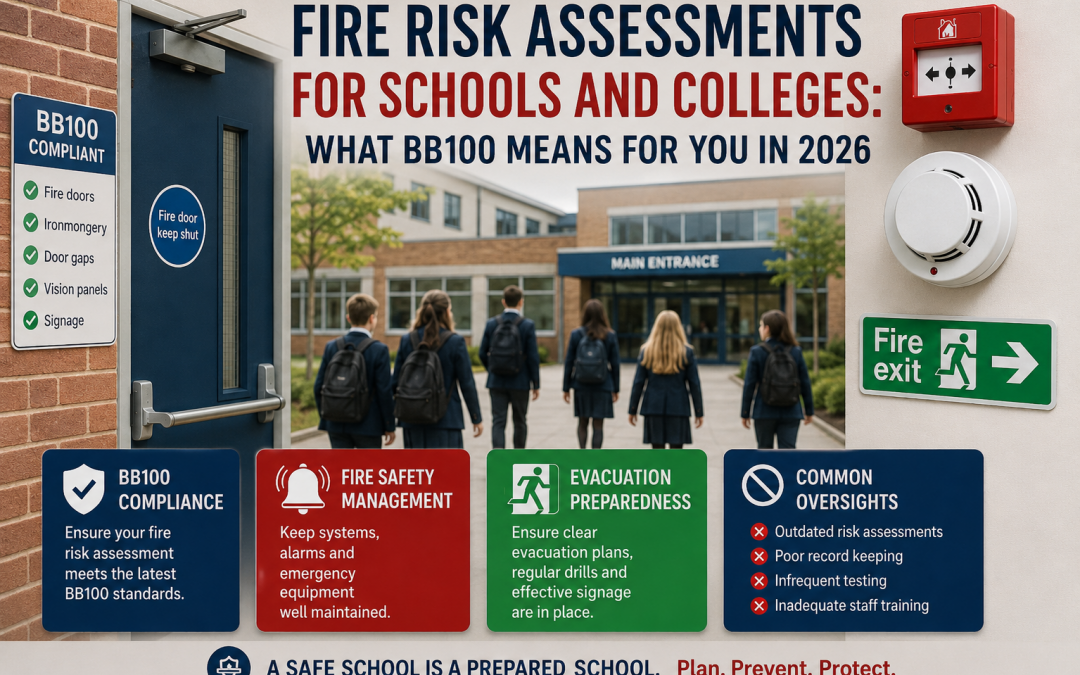
Fire risk assessments for schools and colleges: what BB100 means for you in 2026
This summer term is the right moment to get your fire safety house in order before September. Education estates are busy, complex environments with labs, design and technology suites, sports halls, temporary classrooms, and sometimes sleeping accommodation. Suitable and sufficient Fire Risk Assessments, aligned with BB100, the Regulatory Reform (Fire Safety) Order 2005 and Approved Document B, gives you a clear plan to keep people safe and satisfy regulators.
Safeguard Consultancy has supported schools, colleges and academies for over 30 years. We translate standards into practical actions, from evacuation strategy selection to maintenance planning and evidence management that stands up to Ofsted and local authority scrutiny.
If you lead an education setting and want confidence in your compliance position by September, now is the time to act.
BB100 in 2026, in plain terms
BB100 is Department for Education guidance on fire safety design for schools in England. It explains how to achieve appropriate life safety by integrating means of escape, compartmentation, detection and alarm, and management arrangements. BB100 complements Approved Document B and does not replace your legal duties under the Fire Safety Order. In 2026 you should expect BB100 to continue steering choices such as:
- How your evacuation strategy works in practice for your building form, occupant profile and site management.
- What active and passive measures are appropriate, for example where compartmentation and fire doors support safe escape and business continuity.
- The standard of alarms and maintenance regimes that keep systems reliable during term time and holidays.
Safeguard Consultancy applies BB100 alongside Approved Document B and British Standards so your decisions are defensible and practical on a live school site.
The Responsible Person and who does what
Under the Regulatory Reform (Fire Safety) Order 2005, the Responsible Person in a school or college is typically the employer or the person in control of the premises. In maintained schools that can be the local authority, in academies and independent schools it is usually the proprietor, trust or governing body. Duties include ensuring a suitable and sufficient Fire Risk Assessment is completed and kept up to date, implementing precautions, maintaining systems, training staff, and keeping records.
Who conducts the Fire Risk Assessment? The Responsible Person must ensure it is carried out by a competent person who has sufficient training, experience and knowledge of the premises and relevant guidance. Many education leaders appoint an external fire risk assessor such as Safeguard Consultancy to provide independence, technical depth and sector context.
Typical hazards across education estates
Education buildings contain varied risks. Common features we assess include:
- Science laboratories with flammable liquids, gas services and fume cupboards.
- Design and technology workshops with ignition sources, dust extraction and hot works processes.
- Kitchens and serveries.
- Sleeping risk in boarding houses or residential wings, which changes the evacuation approach and alarm expectations.
- Temporary or modular classrooms where compartmentation and cable penetrations are easily compromised.
- Plant rooms, roof spaces and risers where unsealed penetrations undermine compartmentation.
- Disabled access and inclusion needs requiring Personal Emergency Evacuation Plans (PEEPs).
Understanding how these hazards interact with your building layout, staffing, and pupil age profile is central to a robust assessment.
The five steps of a suitable and sufficient Fire Risk Assessment
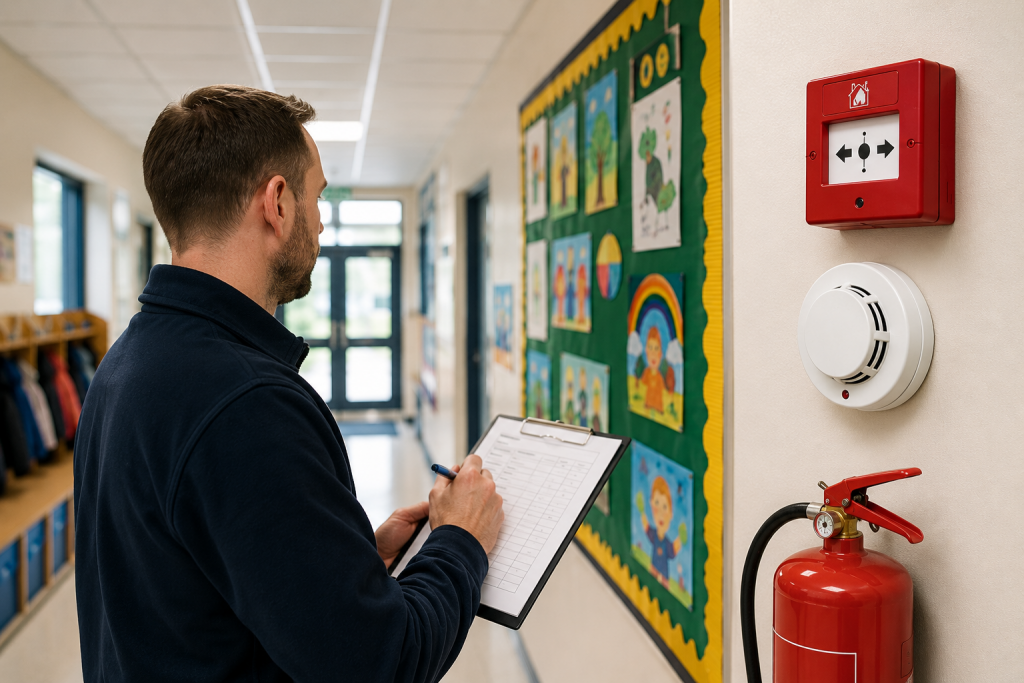
A clear, structured method keeps the assessment usable and auditable. Safeguard Consultancy follows the five classic steps:
- Identify fire hazards, including ignition sources, fuel and oxygen, and examine how fire could start and spread, particularly via compromised compartmentation and doors.
- Identify people at risk, for example pupils, staff, contractors, visitors, and boarding residents, with attention to those needing assistance or PEEPs.
- Evaluate, remove, reduce and protect, weighing existing measures against BB100 and Approved Document B, then recommending proportionate improvements to lower risk to tolerable levels.
- Record, plan, train and inform, capturing findings in plain language, setting out an evacuation strategy, alarm category and maintenance arrangements, and defining roles and drills.
- Review and revise, setting a review cycle and triggers for updating when buildings or use change, for instance after refurbishments, timetable shifts, or staffing changes.
Evacuation strategy, alarms and BB100
BB100 expects evacuation planning that matches your site. In most blocks a simultaneous evacuation remains appropriate. Larger or vertically stacked blocks can justify phased evacuation if the building’s compartmentation, detection and management arrangements support it. For boarding accommodation, a simultaneous strategy is typical due to sleeping risk.
PEEPs are essential for pupils, staff or visitors who need assistance. Your plan should set out roles, equipment such as evacuation chairs, refuge management and training.
Alarm and detection categories, maintenance and testing should be selected and managed against British Standards and BB100 expectations. Weekly tests, periodic servicing by a competent contractor, clear fault management, and term time drill routines should all be recorded. Where phased evacuation is used, address cause and effect, sounder zoning, and staff communication.
For additional context on Building Regulations, see our overview of Building Regulations Part B and how it interfaces with school design choices.
From findings to action, budgets and evidence
An effective Fire Risk Assessment turns into an action plan that leaders can schedule through summer works and beyond. Safeguard Consultancy structures outputs so you can:
- Prioritise by risk, for example immediate issues with fire doors, unsealed penetrations or defective detection, followed by medium-term upgrades and management improvements.
- Plan maintenance, aligning alarm and emergency lighting servicing, fire door inspections and compartmentation repairs to minimise disruption during term time.
- Evidence compliance for auditors by keeping dated reports, photographs, training logs, drill records, maintenance certificates and closed actions together to support the Golden Thread under the Building Safety Act.
If your site needs a deeper look at compartment lines, a targeted fire compartmentation survey can validate the integrity of walls, floors and service penetrations and give product-specific repair guidance.
How often should schools review their Fire Risk Assessment?
There is no single fixed period in law, but schools and colleges should review the assessment regularly and whenever significant change occurs. As a rule of thumb, review at least annually, and sooner if you alter layouts, add temporary classrooms, change occupancy, or after a significant incident. Boarding accommodation and complex multi-block campuses often benefit from tighter review cycles.
Can a school open without a working fire alarm?
No. Operating without a functioning fire detection and alarm system where one is required by your risk assessment and applicable standards is unsafe and likely to breach the Fire Safety Order. If your alarm is impaired, implement a documented interim strategy agreed with a competent person and your monitoring and maintenance providers, for example a waking watch in strictly limited circumstances, and restore full functionality as a priority before normal operation.
Record-keeping and the Golden Thread
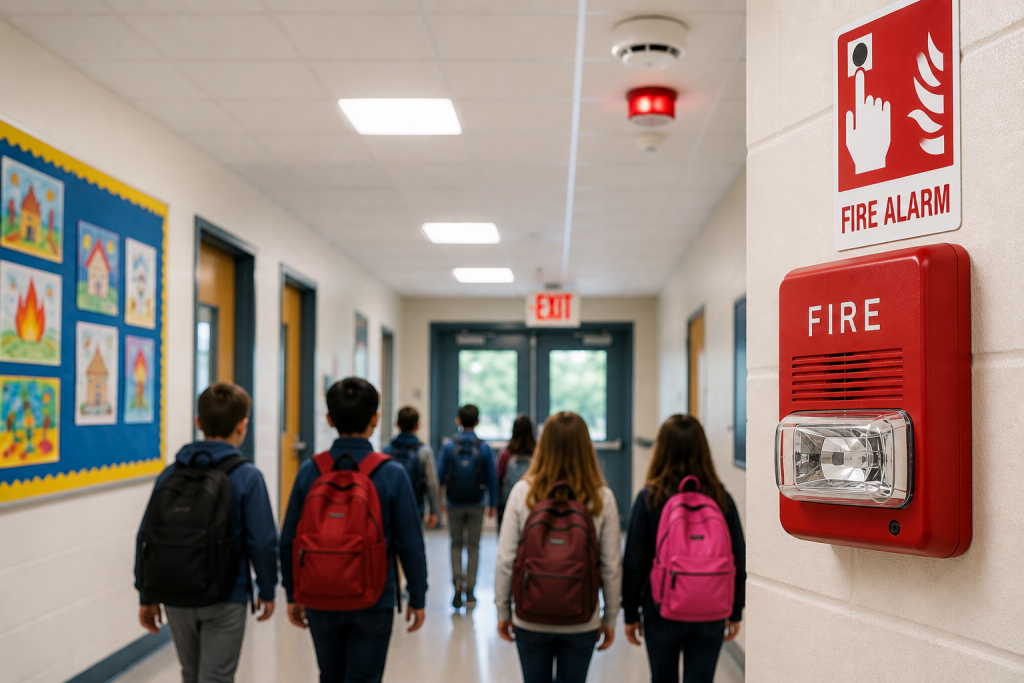
Education leaders should maintain clear, version-controlled records that show what your strategy is, what was found, what you did, and when you checked it again. Link your Fire Risk Assessment, evacuation plan, PEEPs, maintenance logs, contractor certificates, training records and photographs. This evidences compliance and supports the Golden Thread principles many authorities now expect.
For a deeper dive into statutory duties and expectations, explore our guidance on fire safety compliance. When you are ready to develop or refresh your evacuation plan, our practical approach to fire evacuation plans helps you align roles, routes and drills with BB100.
Why commission Safeguard Consultancy now
With over 30 years of experience, Safeguard Consultancy delivers education-focused Fire Risk Assessments, evacuation plans, fire door inspections and compartmentation surveying. We work nationwide, align outputs to BB100, Approved Document B and the Fire Safety Order, and convert findings into prioritised, budget-ready actions you can tackle over the summer to be ready for September.
- Book an education-focused Fire Risk Assessment and training package.
- Align your evacuation strategy, alarm cause and effect, and maintenance regime to BB100 expectations.
- Build an evidence set that stands up to Ofsted and local authority audits.
Call 0333 366 1015 to schedule your assessment and secure workable compliance.
FAQ
- What is BB100? It is Department for Education guidance on fire safety design in schools that complements Approved Document B, informing evacuation, compartmentation, alarms and management, while your legal duties remain under the Fire Safety Order.
- Who is responsible for a school’s Fire Risk Assessment? The Responsible Person, typically the employer or person in control of the premises such as the governing body, trust or proprietor, must ensure a competent person completes and maintains it.
- What are the five steps of a Fire Risk Assessment? Identify hazards, identify people at risk, evaluate and reduce risk, record and plan and train, and review and revise.
- Can a school open without a working fire alarm? No, not where a system is required. If impaired, implement a documented interim arrangement and restore full functionality before normal operation.
- How often does a school need a Fire Risk Assessment? Review at least annually and whenever significant change occurs, with tighter intervals for complex or boarding settings.
Next steps
A suitable and sufficient Fire Risk Assessment aligned with BB100 is the cornerstone of safe operation and smooth audits. Use the summer term to prioritise works, refresh evacuation plans and consolidate evidence so you are ready for September. Safeguard Consultancy can help you move from obligations to action. Call 0333 366 1015 to discuss an education-focused Fire Risk Assessment and training package today.
Suggested resources:
Read our guide to Building Regulations Part B for context on school design choices:
Approved Document B - Safeguard Consultancy
Get focused help creating or updating evacuation plans for schools:
Fire Evacuation Plans - Safeguard Consultancy
Looking Beyond Your Fire Risk Assessment?
Identifying fire risks is only the first step. To maintain compliance and create a safer workplace, staff need regular training and refresher learning.
Safeguard E-Learning provides online fire safety, fire warden and health and safety training courses designed to help employers demonstrate competence and support their wider fire safety responsibilities.
E-Learning - Online Courses - Fire and Health & Safety Courses