
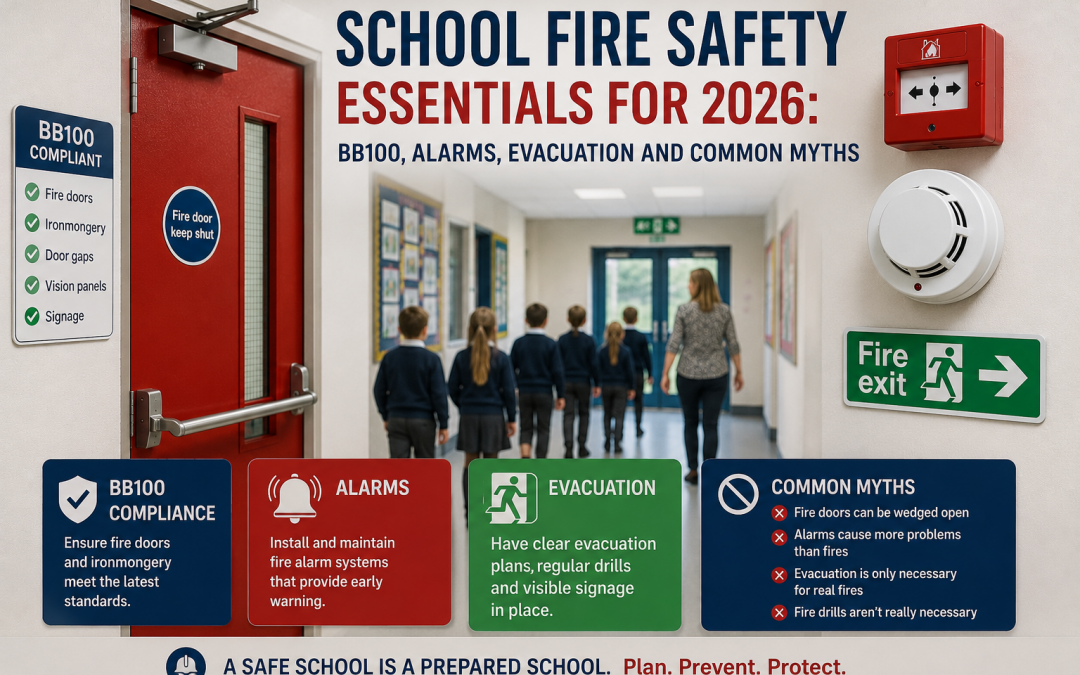
School fire safety essentials for 2026: BB100, alarms, evacuation and common myths
Spring term planning often exposes the same pain points for headteachers, bursars and estates teams. Is our alarm regime sufficient, do our evacuation plans still reflect our pupils and building layout, and how does the latest BB100 guidance change what we must do right now? The stakes are high and the calendar is tight, yet most issues can be resolved with clear roles, simple routines and evidence that stands up to scrutiny.
This guide focuses on operational clarity so you can open with confidence. It dispels stubborn myths, sets out what good looks like for alarms and evacuation, and explains how BB100 fits alongside your legal duties. Where specialist help is wise, Safeguard Consultancy provides practical fire evacuation plans, fire strategy development and building regulations support so your documentation, systems and training align.
BB100 in plain English
BB100 is the Department for Education’s guidance on designing and managing fire safety in schools. It complements Approved Document B and British Standards by focusing on the realities of school buildings and pupils, including young children, pupils with special educational needs and disabilities, and complex timetables. BB100 is not law in itself, but it is widely used by designers, responsible persons and enforcing authorities to judge whether a school’s fire precautions are suitable.
For existing schools, treat BB100 as the benchmark for means of escape, compartmentation strategy, alarm and detection coverage, evacuation planning and management arrangements. It helps you demonstrate that your approach is coherent, risk based and appropriate for your site. For new builds, refurbishments and significant alterations, align BB100 with Building Regulations Part B to evidence compliance from design through handover. If your site has legacy constraints, a clear fire strategy that references BB100 and explains compensatory measures is essential.
If you need a concise route through BB100 expectations and their application to your estate, see Safeguard Consultancy’s guidance on fire risk assessment for schools and BB100, and specialist support with fire strategies that knit design intent to day-to-day management.
Can a school open without a working fire alarm?
No. A school should not open to pupils or staff if the fire alarm system is not working to the extent that it cannot reliably detect, warn and initiate evacuation. Under the Regulatory Reform (Fire Safety) Order 2005, the responsible person must ensure that suitable and sufficient general fire precautions are in place and maintained. A defective, isolated or non-functioning system creates an intolerable risk, often invalidates your risk assessment conclusions and can expose the responsible person to enforcement.
Short-term alternatives, such as temporary manual marshalling with air horns, are not a safe or compliant substitute for a designed system in a normal teaching day. If a fault occurs, follow your escalation flow (below), suspend occupation in affected areas and arrange urgent repair. Record all decisions, control measures and communications.
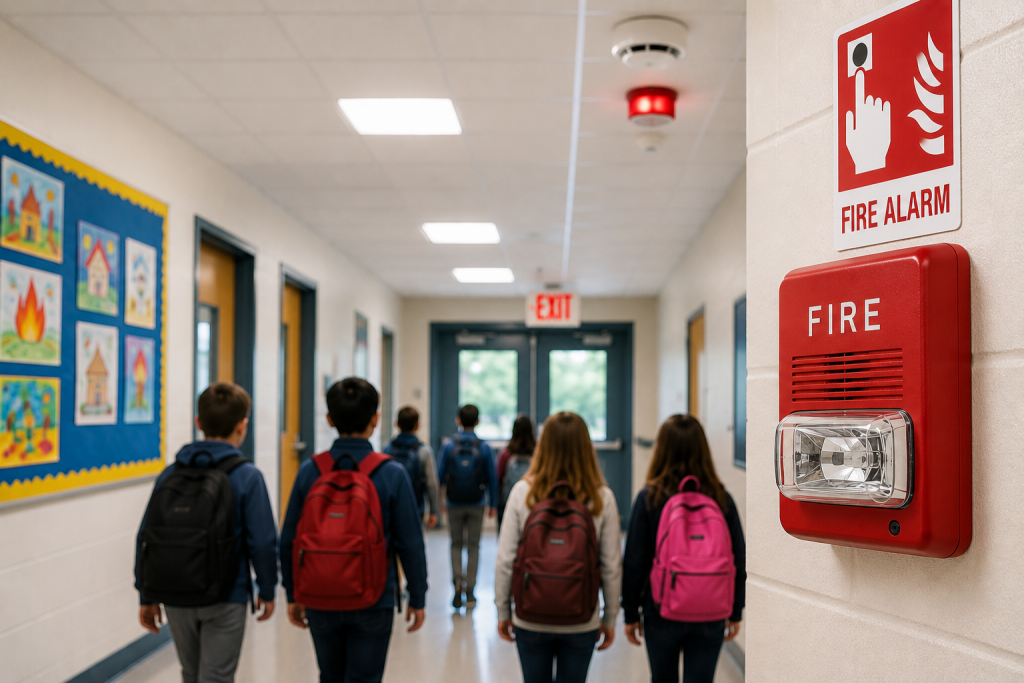
Alarm testing and recording
Routine testing proves the system works, familiarises staff with the signal and demonstrates management control.
- Weekly: Operate at least one manual call point during school hours, rotating locations so each device is tested over time. Confirm audibility across typical teaching conditions.
- Monthly: Check emergency lighting function and interface annunciation where applicable. Review the logbook for missed tests or repeated faults.
- Quarterly or six-monthly: Competent maintenance by a contractor to BS 5839-1, including detection, sounders, interfaces and cause-and-effect checks.
- After works or changes: Test any affected devices and interfaces, then update cause-and-effect if room functions or layouts changed.
Keep a fire logbook. Record date, time, location, person conducting the test, results, corrective actions, and contractor reports. Evidence matters during audits and incident investigations, and it underpins Building Safety Act information management expectations.
Who is responsible for the fire risk assessment?
The responsible person is typically the employer or those in control of the premises, for example the governing body, academy trust, local authority or proprietor. They must ensure a suitable and sufficient fire risk assessment is completed and reviewed, especially after changes to buildings, staffing profiles or pupil needs. Day-to-day tasks can be delegated to competent staff, but legal responsibility remains with the responsible person.
Schools often benefit from an external, competent Fire Risk Assessor for independence and technical depth, particularly in multi-building campuses or where legacy alterations have accumulated. Safeguard Consultancy delivers a comprehensive fire risk assessment service that aligns with the Fire Safety Order, Approved Document B and BB100, with practical, prioritised actions and clear evidence trails.
Evacuation strategies in schools
Most schools use simultaneous evacuation, but BB100 recognises three principal strategies. Your fire strategy should define which applies, where, and why, and your fire evacuation plans must convert that strategy into workable steps.
- Simultaneous evacuation: Everyone leaves as soon as the alarm sounds. This is typical for simple, low-rise school blocks with straightforward escape routes.
- Phased evacuation: Selected areas evacuate first, others hold briefly until directed. This can suit complex or tall buildings where protected lobbies, stairs and compartmentation support sequencing and prevent congestion.
- Progressive horizontal evacuation: Occupants move laterally into a separate, fire-resisting compartment on the same level before vertical evacuation. This is particularly relevant for special schools, early years and settings where mobility, medical needs or supervision ratios require more time and space.
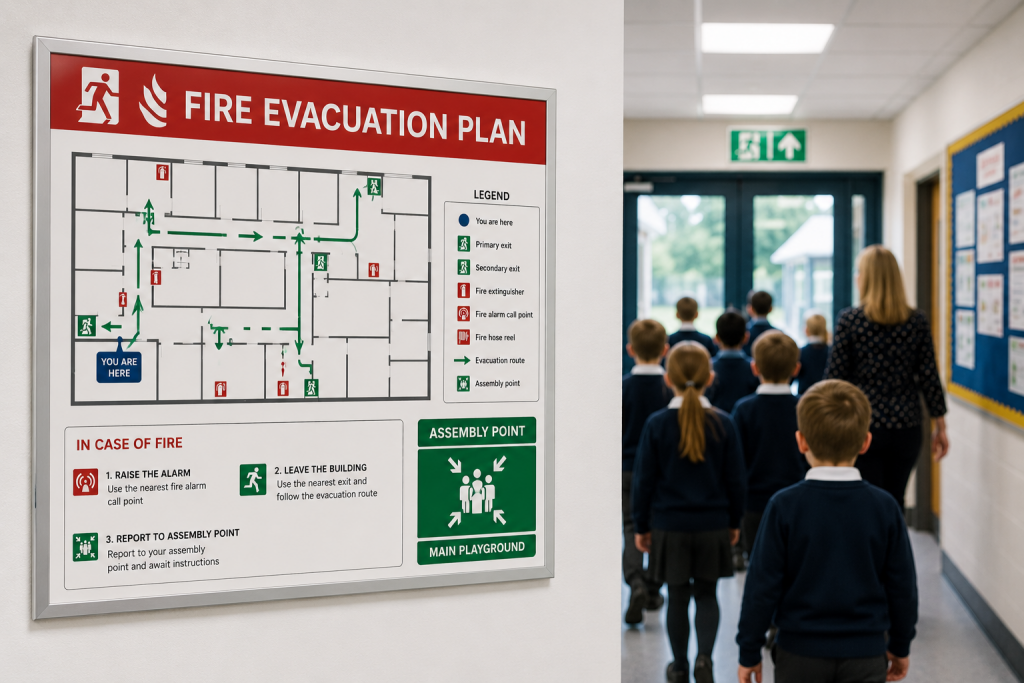
Whichever strategy you adopt, provide Personal Emergency Evacuation Plans, often called PEEPs, for pupils, staff and regular visitors who may need support. Train staff roles, rehearse realistic scenarios and make sure holding areas and refuge points are safe, signed and communicated.
Start-of-term fire safety checklist
Use this quick review to reset control at the start of term.
- Confirm the fire risk assessment review date and action status, especially after any summer or holiday works.
- Validate the fire strategy and evacuation plan reflect current room uses, pupil profiles and any temporary classrooms. Update site plans, assembly points and staff roles.
- Test the alarm weekly from a different call point. Verify audibility with typical background noise and doors closed.
- Check emergency lighting tests are up to date and exits are clear, signed and unlocked during occupation.
- Inspect fire doors for obvious damage, gaps and self-closing. Schedule formal fire door inspections if due.
- Brief staff on alarm signals, evacuation routes, PEEPs and roll-call procedures. Record attendance.
- Verify maintenance records and contractor certifications are on file and current.
Simple escalation flow if issues are found
- Identify and make safe: If the alarm is impaired or escape routes are blocked, pause occupation in affected zones. Do not open areas that you cannot evacuate safely.
- Record and inform: Log the defect, affected locations and interim controls. Notify the responsible person and reception or attendance leads.
- Engage competent help: Call your maintenance provider for urgent rectification. If problems suggest wider strategy or compartmentation issues, seek specialist advice.
- Re-test and reopen: After repair, function-test the system or route, update the logbook and communicate reopening.
- Review the risk assessment: If the issue indicates a systemic concern, trigger a formal review and update the fire strategy or evacuation plan accordingly.
Safeguard Consultancy can assist with targeted fire safety surveys to validate system condition, and with fire compartmentation surveying where integrity is uncertain or recent works may have compromised barriers.
Keeping plans practical and provable
A good plan is one staff can follow under pressure. Keep evacuation instructions concise, post them where decisions happen and align them with your alarm cause-and-effect. Match assembly points to roll-call methods and consider weather, safeguarding and site security. For multi-building sites, ensure inter-building communication is reliable.
Safeguard Consultancy develops clear, site-specific fire evacuation plans and wider fire strategies that link BB100, Building Regulations Part B and real-world timetables. Where you need to evidence compliance more broadly, our guidance on fire safety compliance and Building Safety Act expectations helps you keep records audit-ready without overcomplication.
Quick FAQ for school leaders
- What is BB100 and how does it apply? It is DfE guidance that sets school-focused expectations for fire safety design and management. Use it to benchmark means of escape, compartmentation, alarms and evacuation, alongside Building Regulations and the Fire Safety Order.
- Can we open without a working alarm? No. If the alarm cannot reliably detect and warn, do not occupy affected areas. Make safe, record, repair, then re-test before reopening.
- How often should alarms be tested and recorded? Test weekly from a rotating call point, maintain routine maintenance by a competent contractor, and keep a detailed logbook of all tests, faults and actions.
- Who is responsible for the risk assessment? The responsible person, typically the employer or body in control of the school. They can appoint a competent Fire Risk Assessor, but legal responsibility remains with them.
- What are the three evacuation strategies? Simultaneous, phased, and progressive horizontal evacuation. Choose based on building design, occupancy characteristics and BB100 principles, and support with PEEPs where needed.
Where Safeguard Consultancy can help
- Fire evacuation plans and evacuation strategy support that translate BB100 into workable routines across your estate.
- Fire strategy development for new works and existing buildings, integrating Building Regulations Part B requirements with day-to-day management.
- Independent fire risk assessment with practical, prioritised action plans and clear evidence management.
If you are refreshing your approach for spring term, start with your risk assessment and evacuation plan, then verify alarms, routes and records. For expert, reliable support that aligns with BB100 and Building Regulations, explore Safeguard Consultancy’s fire risk assessment service, specialist fire strategies, and practical fire evacuation plans. Contact 0333 366 1015 to discuss your site and requirements.
Links to helpful resources:
Read how BB100 shapes a modern fire risk assessment for schools at Safeguard Consultancy’s schools guidance:
BB100 - Fire Safety in Schools
See our fire evacuation plans service and how we turn strategy into clear instructions and drawings:
Fire Evacuation Plans - Safeguard Consultancy
For comprehensive, competent fire risk assessment support across education estates:
Fire Risk Assessment - Safeguard Consultancy
Identifying fire risks is only the first step. To maintain compliance and create a safer workplace, staff need regular training and refresher learning.
Safeguard E-Learning provides online fire safety, fire warden and health and safety training courses designed to help employers demonstrate competence and support their wider fire safety responsibilities.
E-Learning - Online Courses - Fire and Health & Safety Courses