
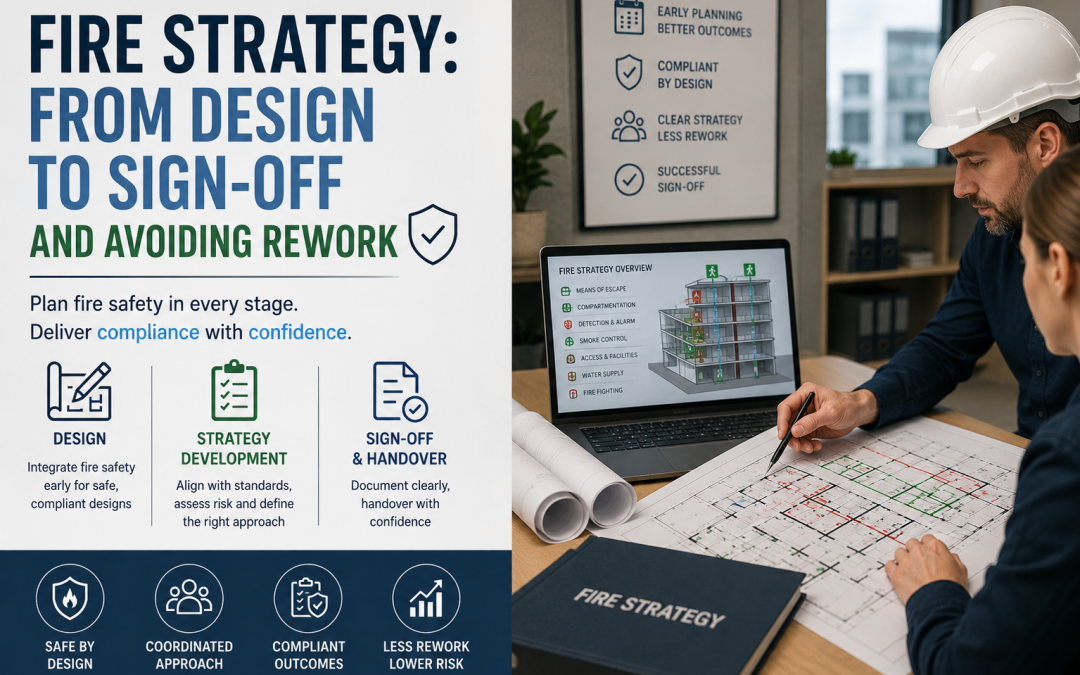
From Design To Sign-Off: When you need a fire strategy and how it saves rework
Summer is when many projects move from sketch to site. It is also when fire safety questions surface under planner scrutiny, Building Regulations checks and contractor RFIs. A clear fire strategy at the right time prevents late design churn, change orders and uncomfortable meetings with regulators.
If you are a developer, architect or building owner shaping a programme for the coming months, this plain-English guide sets out what a fire strategy is, when it is required, how it aligns with Approved Document B, BS 9999 and BS 9991, and when performance-based design to BS 7974 becomes the right tool. We also touch on D12 fire statements for London Plan submissions, evacuation philosophies, procurement essentials and handover aligned to the Golden Thread.
Safeguard Consultancy develops robust fire strategies, delivers fire engineering design and supports Building Regulations compliance across the UK. The focus here is workflow and risk reduction, so you get to sign-off without late surprises.
Fire Strategy Development - Safeguard Consultancy
What a fire strategy is and who creates it
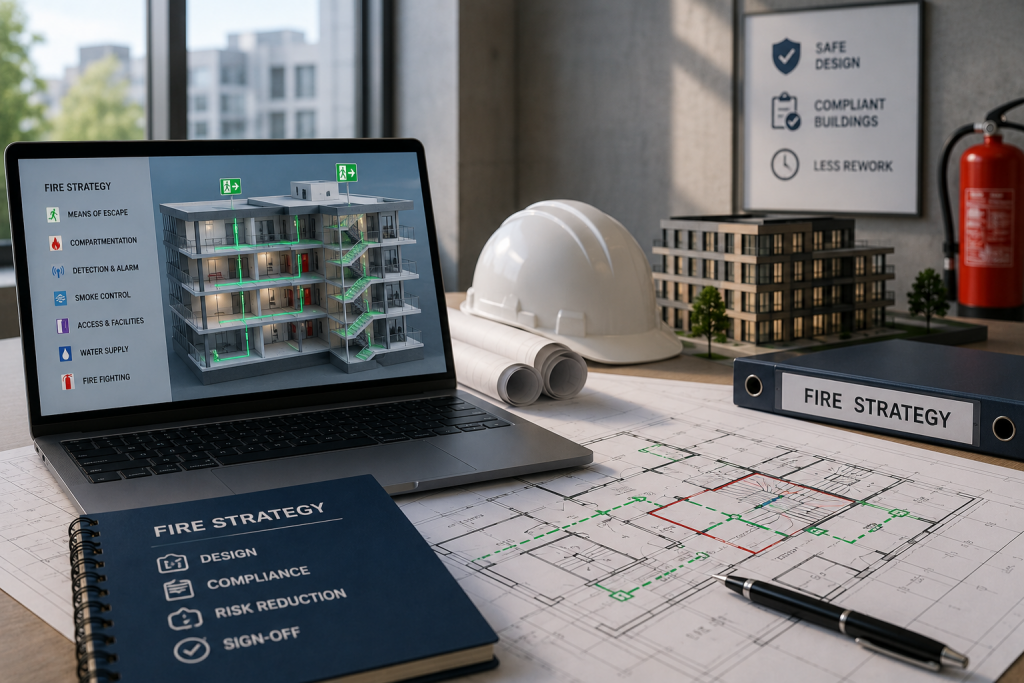
A fire strategy is the project’s fire safety blueprint. It pulls together design intent, applicable guidance and performance criteria into a coherent plan covering means of escape, evacuation philosophy, compartmentation, structural fire resistance, detection and alarm, smoke control, firefighting access and water supplies, and management arrangements once occupied. It explains how people are protected, how fire and smoke spread is limited, and how the building will be maintained to remain safe.
Fire strategies are authored by competent fire engineering consultants. On many schemes, Safeguard Consultancy leads the strategy and coordinates inputs from the design team and specialists, then updates it as the design progresses. The strategy informs the architectural drawings, MEP coordination, product specifications and, later, the building’s fire safety management plan.
When a fire strategy is required
There is no single sentence in law that says every building must have a fire strategy, yet several triggers make it the practical and often expected route to demonstrate compliance:
- New build projects of any scale requiring Building Regulations approval under Building Regulations Part B.
- Material alterations affecting means of escape, compartmentation, structure, facade or services, where Approved Document B principles must be re-checked.
- Changes of use or material changes in use that alter risk profile, occupancy or fire loads.
- Complex, non-standard or large sites where prescriptive guidance alone does not fit, for example mixed use developments, atria, deep basements, tall residential and healthcare.
- Planning submissions that require a fire statement, including D12 fire statements for qualifying London schemes.
Early appointment saves redesign. A strategy prepared at RIBA Stage 2 or 3 typically removes uncertainty before planning, allows coordinated design decisions and avoids later rework when contractors find conflicts in shafts, risers, smoke control, or protected lobbies.
How it interfaces with Approved Document B, BS 9999 and BS 9991
Approved Document B (ADB) is the primary government guidance that shows common ways to meet the functional requirements of Building Regulations in England. It is prescriptive in style and widely used across typical building types.
Approved Document B - Safeguard Consultancy
BS 9999 (non-residential) and BS 9991 (residential) are British Standards that provide a risk-based, flexible framework. They allow design choices using fire growth rates, travel distances and management levels to justify solutions that may differ from pure ADB prescriptions while still achieving equivalent safety outcomes.
BS 9999 - Fire Safety in the Design, Management and Use of Buildings
BS 9991 - Fire Safety in the Design, Management and Use of Residential Buildings
In practice, a robust strategy references ADB as the baseline, then draws on BS 9999 or BS 9991 where risk-based flexibility or a better fit is needed. For healthcare and schools, HTM 05 and BB100 apply. For tall and complex buildings, the strategy may combine guidance documents and indicate where performance-based design is used to validate specific elements.
If you need a refresher on the purpose and scope of Building Regulations Part B, Safeguard’s overview of building regulations part b provides a helpful primer.
When performance-based fire engineering (BS 7974) is appropriate
BS 7974 provides a structured methodology for performance-based fire engineering. It is appropriate where:
- The design intentionally departs from prescriptive guidance but requires an equivalent or better level of safety to be demonstrated.
- Complex geometries, large open spaces, smoke reservoirs, or novel materials make prescriptive application impractical.
- Atria, extended travel distances, alternative stair arrangements, bespoke smoke control, or reduced fire resistance are proposed with compensatory measures.
- Project constraints or heritage requirements limit conventional solutions.
Under BS 7974, quantitative analysis, computational fluid dynamics or timed egress calculations are used to test scenarios and show that people can escape safely, fire and smoke are controlled, and firefighting operations are tenable. Safeguard Consultancy’s fire engineering design and fire engineering solutions follow this route where it adds certainty and avoids unnecessary overdesign.
BS 7974 - Application of Fire Safety Engineering Principles to the Design of Buildings
What planners and regulators expect, including D12
At planning stage, more authorities are asking for clear statements about fire safety intent. In London, many schemes require a D12 fire statement to support London Plan Policy D12. This typically outlines means of escape, evacuation strategy, access for fire service, water supplies, and how construction will consider fire safety constraints. It does not replace a full Building Regulations submission but sets early expectations.
At Building Control gateway, regulators will expect a coordinated fire strategy, relevant calculations, drawings showing compartmentation and escape, smoke control schematics, and evidence of consultation where specialist systems are proposed. For higher risk buildings, information management to support the Golden Thread under the Building Safety Act is expected, with controlled versions, change logs and traceable decisions.
Evacuation philosophies and why they matter
The evacuation philosophy should align with building use and resilience. Common approaches include simultaneous evacuation for simple buildings, phased evacuation in tall office or mixed use schemes, and stay put for certain residential designs where compartmentation supports it. The strategy explains how alarms, voice systems, fire doors, smoke control and management roles work together, and how personal emergency evacuation plans are supported where needed.
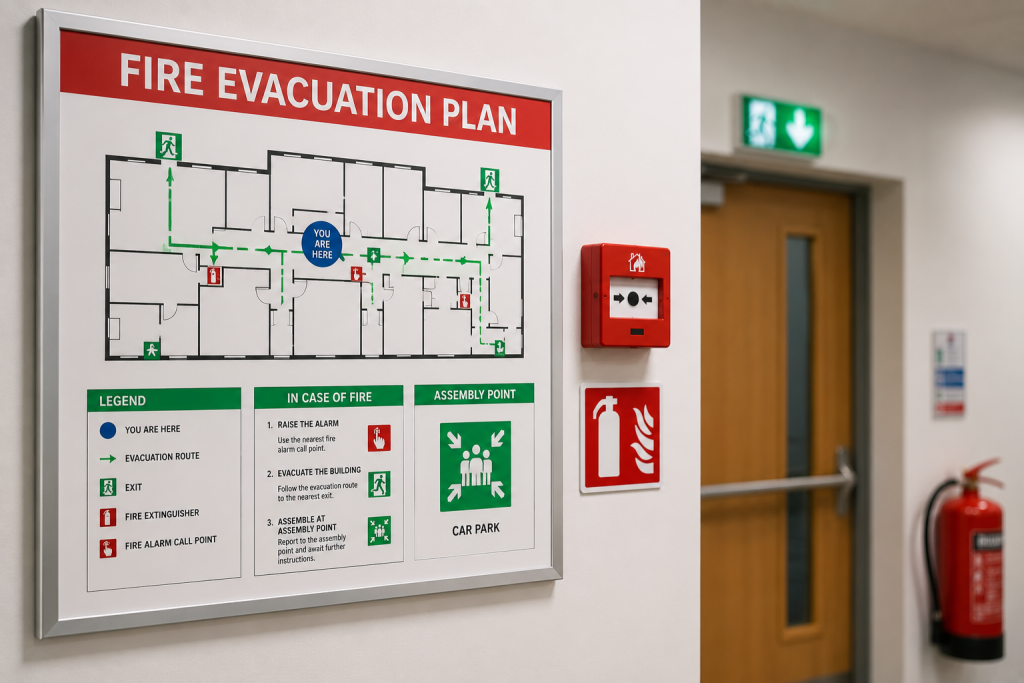
Safeguard Consultancy also prepares practical fire evacuation plans for occupancy, translating the strategy into routes, roles and procedures that building managers can implement.
Procurement checklist: getting the inputs right
A good brief accelerates strategy development and avoids iteration. Before you procure, assemble:
- Current general arrangement drawings, sections and elevations, including escape stairs, shafts and risers.
- Fire and life safety drawings if available, legacy strategies, and any previous regulator feedback.
- Site surveys and reports, for example facade details, compartmentation records, or smoke control data.
- Design parameters, occupancy profiles, evacuation philosophy preferences, management constraints, and any heritage or planning conditions.
- Responsibilities matrix covering authoring, coordination, updates during design changes, and construction-phase queries.
- Programme dates for planning, Building Regulations submission, tender and start on site.
If your building has existing fabric or unknown compartmentation, consider a targeted fire compartmentation survey or broader fire safety surveys to surface constraints early and avoid redesign when ceilings are opened.
Handover and the Golden Thread
At completion, the strategy should be updated to as-built and handed over alongside test certificates, commissioning data, record drawings and operation and maintenance manuals. Under the Building Safety Act, keeping a clear, version-controlled record supports the Golden Thread of information. This helps dutyholders manage change, plan maintenance and demonstrate fire safety compliance throughout the building’s life.
Safeguard Consultancy aligns deliverables and evidence with Building Safety Act expectations so owners and operators can manage audits with confidence.
How a robust strategy saves rework
Most expensive fire safety rework stems from late discovery: an unprotected shaft where a protected lobby is needed, a travel distance exceeded by fit-out changes, or a smoke control scheme that clashes with MEP coordination. A strategy prepared and maintained through design reviews allows your team to make informed choices early, resolve conflicts in 2D and 3D, and specify products that meet the intent. That means fewer RFIs, fewer site instructions and a smoother path to sign-off.
FAQ
- What is a fire strategy and who writes it?
A documented blueprint for fire safety across design, construction and operation, authored by competent fire engineering consultants such as Safeguard Consultancy.
- Are fire strategies a legal requirement and when are they needed?
They are the practical route to demonstrate compliance for new builds, material alterations, changes of use and complex sites, and are often expected by planners and Building Control. London schemes may also need a D12 fire statement at planning.
- What is the difference between Approved Document B and BS 9999 or BS 9991?
ADB is prescriptive government guidance. BS 9999 and BS 9991 are risk-based British Standards offering flexible design routes for non-residential and residential buildings respectively.
- When is BS 7974 performance-based design used?
When prescriptive routes are not suitable or when alternative solutions must be justified using analysis, for example in atria, extended travel distances or complex geometries.
- What documentation do regulators expect?
At planning, a clear statement of fire safety intent, including D12 in London where applicable. At Building Control, a coordinated fire strategy with drawings, calculations, system schematics and evidence aligned to the chosen guidance.
Work with Safeguard Consultancy
Safeguard Consultancy develops fire strategies, undertakes fire engineering design and supports Building Regulations submissions nationwide. If your project would benefit from a short discovery call or a proposal that maps tasks, deliverables and programme, contact our team on 0333 366 1015.
To explore related services that often run alongside strategy development, you may find these useful:
- A concise overview of fire safety compliance services to understand dutyholder expectations under current legislation.
- Practical guidance on commissioning a fire compartmentation survey when you need certainty about barrier integrity before tender.
Summary
Get the strategy right early, reference the right guidance, and keep it live through design and construction. That is how projects move from design to sign-off without painful rework. Safeguard Consultancy can lead your fire strategy, deliver performance-based solutions where needed, and align evidence for the Golden Thread so you hand over with confidence.
Identifying fire risks is only the first step. To maintain compliance and create a safer workplace, staff need regular training and refresher learning.
Safeguard E-Learning provides online fire safety, fire warden and health and safety training courses designed to help employers demonstrate competence and support their wider fire safety responsibilities.
E-Learning - Online Courses - Fire and Health & Safety Courses
I can’t get enough of your insightful articles and engaging stories. Thank you for sharing your passion with the world!